
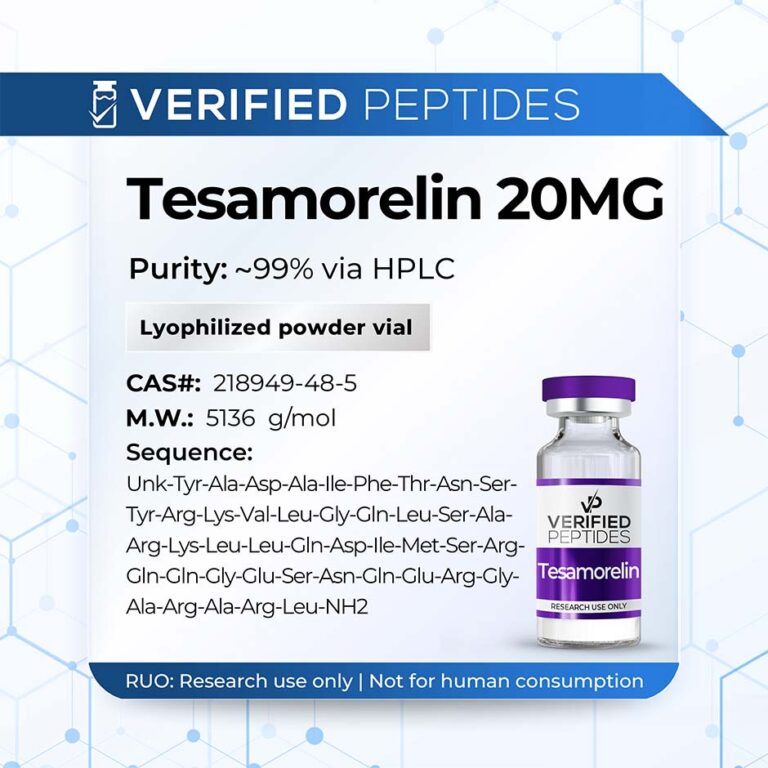
Tesamoreln (20MG)
Price range: £80.00 through £119.00
Tesamorelin 20mg – Third-Party Tested Peptide
Global Peptides Lab presents Tesamorelin 20mg with a focus on batch quality verification and transparent laboratory testing. According to the supplied product information, this batch has undergone third-party testing for purity, weight verification and endotoxins (LPS). These checks provide important quality information for evaluating the material. Review the available batch documentation and certificate of analysis for the reported results, testing methods and laboratory details before making an assessment.
Batch testing highlights:
- Purity: Laboratory analysis of the sample’s reported purity.
- Weight verification: Assessment of the measured sample quantity or mass.
- Endotoxins (LPS): Testing for lipopolysaccharide contamination.
Testing results apply to the batch and the specific tests performed. They do not, by themselves, establish sterility, clinical effectiveness or suitability for human use.
Tesamorelin 20mg – Third-Party Tested Peptide
Product Overview
At Global Peptides Lab, product transparency and quality documentation are important considerations when evaluating peptide materials. Tesamorelin 20mg is a peptide product presented with a focus on laboratory verification, batch identification and clear quality information. For customers researching tesamorelin, understanding the product’s identity and the available testing documentation is an important starting point.
Tesamorelin is a synthetic peptide related to growth hormone-releasing hormone (GHRH). It acts on the body’s growth hormone regulatory pathway. Its established medical use is in a specific prescription treatment for excess abdominal fat in adults with HIV-associated lipodystrophy. This does not mean that every tesamorelin product has been approved for medical use or that the product described here has demonstrated clinical benefits.
The product information supplied for this batch states that third-party laboratory testing was performed to assess purity, verify weight and examine endotoxins (LPS). These quality checks can help readers understand what was evaluated, but the actual laboratory results and methods should be reviewed before drawing conclusions about the material.
Key Product Information
- Product name: Tesamorelin
- Listed quantity: 20mg
- Product category: Peptide
- Quality documentation: Third-party batch testing, as reported in the supplied product information
- Reported testing categories: Purity, weight verification and endotoxins (LPS)
- Supporting documentation: Refer to the applicable batch certificate of analysis, where available
The listed quantity identifies the product’s stated amount; it should not be confused with a laboratory finding about purity or concentration. Buyers and researchers should consult the actual product specifications and accompanying documentation for the details relevant to their intended evaluation.
What Is Tesamorelin?
Tesamorelin is a synthetic peptide that acts on the growth hormone-releasing hormone receptor pathway. This pathway is involved in regulating the release of growth hormone from the pituitary gland. The resulting biological activity is part of a complex endocrine system, and its effects depend on the substance, formulation, individual circumstances and clinical context.
In the United States, prescription tesamorelin products have an established indication for reducing excess abdominal fat in adults with HIV-associated lipodystrophy. That indication is specific and should not be generalized to ordinary weight management, bodybuilding, cosmetic use or anti-aging purposes.
People researching tesamorelin should distinguish between information about the active peptide, evidence from clinical studies and the independently verified characteristics of an individual commercial batch. These are separate questions and require different kinds of evidence.
Third-Party Laboratory Testing
Laboratory testing is an important part of product quality evaluation. According to the information provided for this batch, the material has been tested by a third-party laboratory in three areas: purity, weight and endotoxins (LPS).
1. Purity Testing
Purity testing evaluates the proportion of the material attributed to the target compound under a specified analytical method. Depending on the method used, the analysis may help identify the target compound and assess the presence of detectable impurities or related substances.
A reported purity percentage must be interpreted in the context of the laboratory method. For example, a chromatographic purity result does not necessarily establish the total mass of the active compound in a vial, nor does it prove that every possible contaminant is absent.
For transparent reporting, the applicable certificate of analysis should identify the analytical method, measured result, acceptance criteria where relevant, batch number and testing laboratory.
2. Weight Verification
Weight verification concerns the measured mass or quantity of material evaluated during testing. It is different from purity analysis because a sample may meet a stated weight specification without necessarily meeting a particular purity specification.
When reviewing weight verification for a peptide product, check what was actually measured. The result may relate to the contents, sample mass or another defined measurement. Packaging and measurement details should be clear enough to avoid confusion between the listed quantity and a laboratory-verified value.
Global Peptides Lab should publish a specific measured result only when it is supported by the relevant batch documentation.
3. Endotoxin (LPS) Testing
Lipopolysaccharides, commonly abbreviated as LPS, are components of the outer membrane of certain bacteria and are commonly referred to as bacterial endotoxins. Endotoxin testing evaluates whether detectable endotoxin is present under the conditions of the test.
The interpretation of an endotoxin result depends on the analytical method, units, detection limit and relevant acceptance criteria. A statement that a product has been tested does not automatically mean that the result was below a particular limit.
Endotoxin testing is also distinct from sterility testing. A result for one quality attribute should not be presented as proof of another. Readers should consult the actual report for the finding and its limitations.
Why Batch Documentation Matters
A third-party laboratory report can provide useful information when it is clearly linked to the product batch being evaluated. Good documentation generally identifies the sample, batch or lot number, laboratory, test date, methods used and results reported.
For Tesamorelin 20mg, the most useful supporting material would be a certificate of analysis that allows readers to connect the product listing to the tested batch. Where available, publish the verified results instead of relying only on general statements such as “laboratory tested” or “high purity.”
A certificate should also be interpreted within its scope. A report can support specific findings about the sample and tests performed, but it cannot automatically establish the safety, efficacy, sterility or regulatory approval of a product.
Important Research and Medical Considerations
Tesamorelin has biologically active effects and is not simply an ordinary laboratory ingredient. Prescription products have specific medical indications, contraindications and warnings that must be considered by qualified healthcare professionals.
Research findings about tesamorelin should not be treated as evidence that an unapproved formulation or independently marketed batch will produce the same results. Product quantity, laboratory purity, clinical efficacy and patient safety are distinct matters.
This product description is informational and does not constitute medical advice, a treatment recommendation or instructions for administration. Anyone seeking treatment involving tesamorelin should consult a qualified healthcare professional and use only products that are legally authorized for the relevant purpose.
Frequently Asked Questions
What is Tesamorelin 20mg?
It is a product listing for a stated 20mg quantity of tesamorelin, a synthetic peptide related to growth hormone-releasing hormone. The listed quantity should be checked against the product specification and applicable batch documentation.
Has this batch undergone third-party testing?
According to the product information supplied to Global Peptides Lab, the batch has undergone third-party laboratory testing for purity, weight verification and endotoxins (LPS). The corresponding report should be consulted to verify the laboratory, methods and actual results.
What does tesamorelin purity testing show?
Purity testing assesses the target material and detectable impurities within the limits of the analytical method used. It does not independently prove sterility, safety for human use or clinical effectiveness.
What is endotoxin testing?
Endotoxin testing evaluates the presence or level of bacterial lipopolysaccharides in a sample. Results should be interpreted using the reported units, analytical method and applicable acceptance criteria.
Does third-party testing mean the product is approved for medical use?
No. Third-party testing and regulatory approval are different. Laboratory testing can provide evidence about specified sample characteristics, whereas authorization for medical use depends on the relevant regulatory requirements and the particular product.
Where can I find the test results?
Consult the certificate of analysis or other batch-specific laboratory report supplied with the product, if available. The documentation should match the listed batch and identify the tests performed and the results obtained.
Conclusion
Global Peptides Lab emphasizes clear product information and transparent quality documentation. For customers researching Tesamorelin 20mg, the supplied product information identifies third-party testing for purity, weight verification and endotoxins (LPS) as the main quality checks for this batch.
The most reliable way to assess these claims is to review the corresponding laboratory report and confirm that its results match the product’s batch identification. Clear documentation helps readers distinguish reported laboratory findings from assumptions about safety, clinical benefits or regulatory status.
| Quantity | 1-4, 10-24, 20+, 5-9 |
|---|
Be the first to review “Tesamoreln (20MG)”
Related products

Peptides

Peptides

Peptides

Peptides
Peptides

Peptides

Peptides

Peptides
Reviews
There are no reviews yet.