
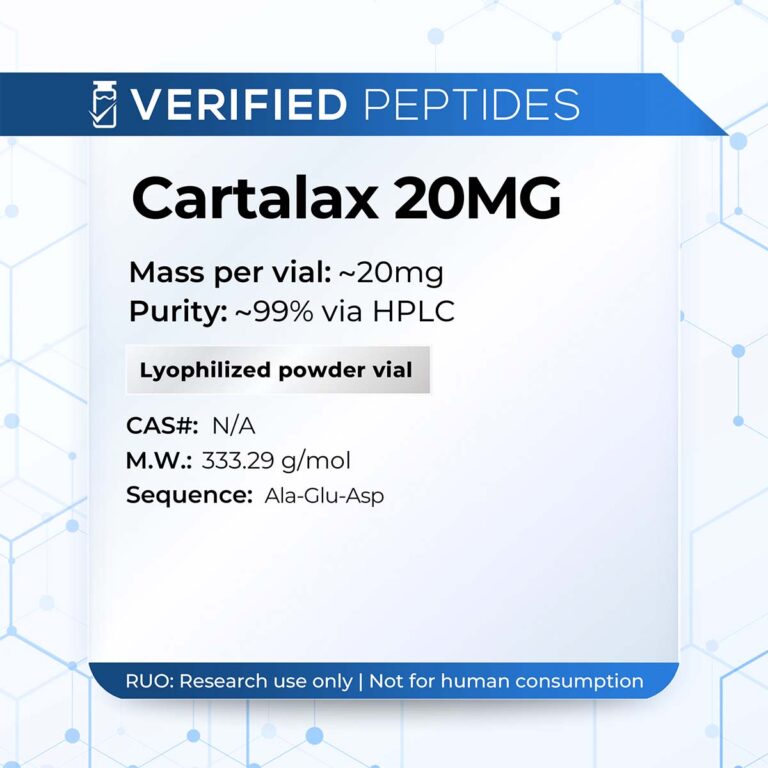
Cartalax (20MG)
Price range: £41.00 through £55.00
Cartalax 20mg is a research peptide product offered by Global Peptides Lab for qualified laboratory and scientific research applications. This product listing provides essential information about product specifications, quality assessment, and available testing documentation.
Each batch should be supported by appropriate documentation addressing peptide purity, product weight, and endotoxin levels (LPS). Researchers can consult the available batch-specific test results and product information before making a purchasing decision.
Product highlights:
- Product: Cartalax
- Labelled quantity: 20mg
- Quality checks: Purity, weight, and endotoxins (LPS)
- Documentation: Batch-specific test results, where available
- Intended use: Laboratory research only; not for human or veterinary use
Cartalax 20mg – Research Peptide Product Information
Cartalax 20mg is a peptide research product listed by Global Peptides Lab for laboratory and scientific research applications. Researchers looking for peptide research materials need clear product specifications, reliable quality information, and access to relevant testing documentation. This product page provides an overview of the labelled quantity, quality assessment criteria, and important considerations when evaluating a research peptide.
Cartalax is associated with the wider field of peptide bioregulator research. However, the scientific evidence, intended research applications, and relevance of any findings must be assessed using appropriate published literature. A product description alone should not be treated as proof of a particular biological effect, medical benefit, or clinical outcome.
At Global Peptides Lab, product information should be presented transparently so that researchers can evaluate the material based on documented specifications rather than unsupported promises.
Product Specifications
Before purchasing a laboratory peptide, it is important to understand the basic information supplied with the product.
- Product name: Cartalax
- Labelled quantity: 20mg
- Product category: Research peptide
- Quality assessment: Purity, weight, and endotoxin testing
- Documentation: Certificate of Analysis (COA) or equivalent batch-specific laboratory report, where available
- Intended application: Laboratory research only
The stated 20mg quantity represents the labelled product amount. Actual product quantity and the method used to verify it should be confirmed through the manufacturer’s specifications and appropriate analytical documentation.
Understanding Cartalax in Peptide Research
Peptides are molecules made from amino acids connected by peptide bonds. They are studied in various areas of biological and biochemical research because their structures can influence interactions with biological systems.
Cartalax is discussed in the context of peptide bioregulators. Interest in this broader research category does not establish that a particular product has proven effects in humans. Researchers should distinguish preliminary findings, laboratory observations, animal studies, and controlled human clinical evidence.
When evaluating research involving Cartalax, it is important to consult credible scientific publications and assess the methods, limitations, and reproducibility of the reported findings. Claims concerning ageing, cellular function, recovery, or other biological outcomes should not be considered established without suitable supporting evidence.
Global Peptides Lab provides this product information to help customers understand the research material being listed, rather than to make medical claims or guarantee experimental results.
Purity Testing and Quality Assessment
Purity is an important consideration when evaluating a peptide intended for laboratory research. It describes the proportion of the material represented by the target compound under a specified analytical method. The reported purity value and its interpretation depend on the method, reference standards, and laboratory procedures used.
For Cartalax 20mg, customers should review the applicable batch-specific analytical report to identify the measured purity, the testing method, the laboratory responsible for the analysis, and the date of testing.
Analytical techniques such as high-performance liquid chromatography (HPLC) may be used to assess peptide purity. Mass spectrometry may provide complementary information about molecular mass or identity. These methods answer different questions, and one result should not automatically be treated as proof of every aspect of product quality.
A stated purity percentage should only be published when supported by the relevant documentation. Purity results alone do not establish sterility, biological activity, safety for human use, or the absence of every possible contaminant.
Product Weight Verification
Product weight is another important quality-control consideration. The labelled quantity helps researchers identify the amount of material represented by the product specification, while suitable analytical or gravimetric procedures can help verify relevant weight measurements.
When reviewing a weight test, customers should check what was measured. For example, net product mass, container weight, and the amount of target peptide are not necessarily interchangeable measurements. The testing report should clearly identify the measured quantity and the method used.
For a product labelled 20mg, batch documentation should clarify whether the reported value refers to the peptide content or another measurement. Clear reporting helps prevent confusion and supports better record-keeping in research environments.
Endotoxin Testing (LPS)
Endotoxins are bacterial components that can trigger biological responses under certain conditions. Lipopolysaccharides (LPS) are a major type of endotoxin associated with the outer membrane of Gram-negative bacteria.
Endotoxin testing can be relevant to laboratory materials where endotoxin contamination could interfere with experimental results. The appropriate testing method, acceptance criteria, and reporting units depend on the material and the intended research application.
Customers evaluating Cartalax should look for a batch-specific endotoxin report that identifies the analytical method, result, units, and applicable limit. Where relevant, the documentation should also explain whether the reported result is below the method’s detection or quantification limit.
A statement that a product has been tested for endotoxins is not the same as a statement that it is endotoxin-free. Likewise, endotoxin testing does not establish sterility or suitability for injection. These distinctions are important when interpreting laboratory quality reports.
Why Laboratory Documentation Matters
Research materials should be assessed using evidence that can be reviewed and interpreted. A useful Certificate of Analysis typically identifies the product or batch, the tests performed, the corresponding results, and relevant analytical methods.
Before purchasing a research peptide, consider the following:
- Product identity: Does the documentation identify the material being supplied?
- Purity: Is a numerical result provided, with the testing method identified?
- Weight: Is the measured quantity clearly defined?
- Endotoxins: Are the result, units, method, and applicable acceptance criteria reported?
- Batch traceability: Can the report be linked to the specific product batch?
- Report credibility: Is the testing laboratory identified, and can the documentation be verified?
These checks help customers make informed decisions about research materials. They also provide a more meaningful basis for evaluating quality than a general claim of laboratory testing.
Storage and Handling Information
Peptide stability can depend on formulation, packaging, temperature, moisture, light exposure, and other environmental conditions. Storage requirements should therefore be based on the manufacturer’s verified instructions for the specific product.
Keep the product in its original, appropriately labelled packaging and consult the accompanying documentation for handling and storage requirements. Avoid assuming that every peptide has identical stability characteristics or that a general storage recommendation applies to all formulations.
Laboratory personnel should follow their institution’s chemical and biological material handling procedures, use suitable protective equipment where required, and maintain appropriate records. Any additional preparation or handling should be guided by validated laboratory protocols rather than assumptions based on the product name.
Frequently Asked Questions
What is Cartalax 20mg?
Cartalax 20mg is a research peptide product listed by Global Peptides Lab. Its labelled quantity is 20mg, and its specifications and quality should be assessed using available product documentation.
What tests should I look for before purchasing?
Review the available purity, weight, and endotoxin (LPS) testing results. Where available, consult a batch-specific Certificate of Analysis and verify the methods and reported results.
Does a purity result guarantee product quality?
No. Purity is only one aspect of quality assessment. Identity, quantity, possible contaminants, endotoxin levels, handling, and other relevant characteristics may require separate evaluation.
Does endotoxin testing mean the product is sterile?
No. Endotoxin testing and sterility testing assess different properties. An endotoxin result alone does not establish sterility or suitability for human use.
Is Cartalax approved as a medicine?
This product listing does not establish regulatory approval as a medicine. Customers should check the relevant regulatory authority’s current information rather than assume that a research product is approved for clinical use.
Is this product intended for human consumption?
No. This listing is intended for laboratory research purposes only. It is not offered as a food, dietary supplement, or medicine, and it should not be represented as approved for human or veterinary use.
Order Cartalax from Global Peptides Lab
Global Peptides Lab aims to provide clear product specifications and relevant quality information for customers evaluating research materials. Before placing an order, review the product details and any available batch-specific documentation to determine whether the material meets your laboratory’s documented requirements.
For research purchasing decisions, prioritise transparent specifications, traceable testing results, and credible scientific evidence. These practices help support responsible evaluation of peptide research materials.
Research-use notice: This product is intended for laboratory research only. It is not intended for human or veterinary consumption, diagnosis, treatment, or prevention of disease.
| Quantity | 1-4, 10-24, 20+, 5-9 |
|---|
Be the first to review “Cartalax (20MG)”
Related products

Peptides

Peptides

Peptides

Peptides

Peptides

Peptides

Peptides
Reviews
There are no reviews yet.