
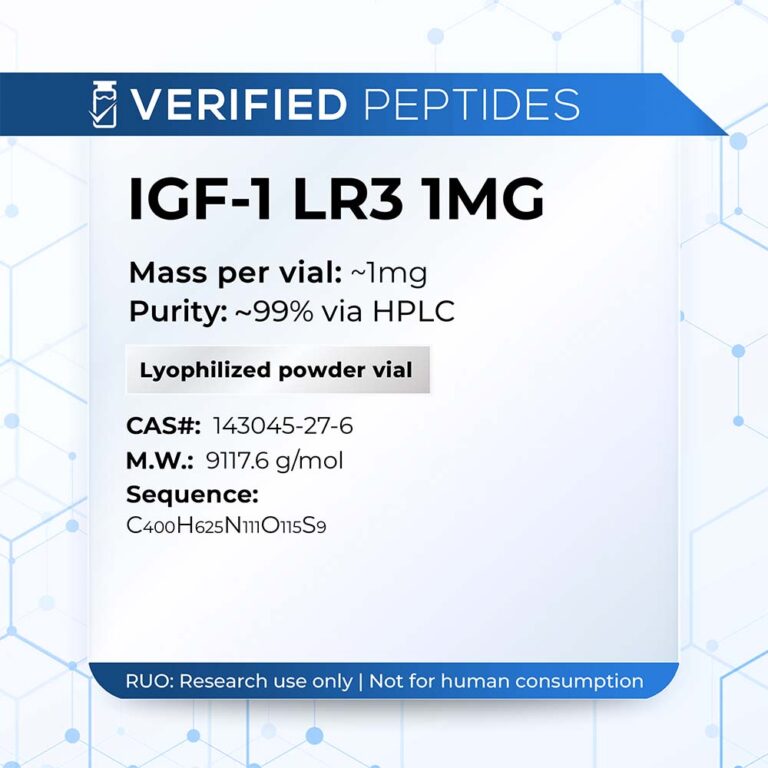
IGF-1 LR3 (1MG)


£65.00
IGF-1 LR3 1mg – Research Peptide
Global Peptides Lab presents IGF-1 LR3 1mg for qualified laboratory and scientific research applications. This research compound is a long-acting analogue of insulin-like growth factor 1 (IGF-1) studied for its interactions with IGF-related biological pathways. Product quality checks cover purity, weight, and endotoxins (LPS), with results subject to the available batch-specific documentation. Review the product specifications and supporting test records before making a purchasing decision.
IGF-1 LR3 1mg – Research Peptide
Product Overview
IGF-1 LR3 1mg is a research-grade peptide product intended for qualified scientific and laboratory research. IGF-1 LR3 is a modified analogue of insulin-like growth factor 1, a protein involved in biological processes associated with cellular growth, differentiation, and metabolism. Researchers study this compound to better understand IGF-related signalling pathways and their roles in experimental biological systems.
At Global Peptides Lab, product information should be clear, accessible, and supported by appropriate documentation. This product listing provides an overview of the compound, its research background, key product specifications, and the quality checks reported for the material.
IGF-1 LR3 is an investigational research compound, not an approved treatment for general medical use. It should not be presented as a medicine, a supplement, or a product proven to deliver specific health, muscle-building, or weight-management outcomes.
What Is IGF-1 LR3?
IGF-1 LR3 is a modified form of insulin-like growth factor 1 (IGF-1). Its name refers to structural modifications that distinguish it from native IGF-1, including an extended amino-acid sequence and an alteration in its structure.
These modifications have been investigated for their effects on interactions with IGF-binding proteins and the compound’s biological activity under experimental conditions. The scientific interest in this analogue relates to how structural changes can influence protein interactions and signalling in laboratory models.
IGF-1 belongs to a broader biological system involved in growth and development. Its activity is connected to the growth hormone and IGF signalling network, although the pathways involved are complex and vary according to the biological context. Findings from laboratory experiments do not automatically establish safety, effectiveness, or appropriate use in humans.
For this reason, research involving IGF-1 LR3 requires suitable scientific oversight, validated procedures, and careful interpretation of experimental results.
Key Product Specifications
The product is identified by the following basic information:
- Product name: IGF-1 LR3
- Listed quantity: 1mg
- Product category: Research peptide
- Research area: IGF-related biological signalling
- Quality assessment areas: Purity, weight, and endotoxins (LPS)
- Documentation: Batch-specific testing records, where available
The listed 1mg quantity identifies the stated product amount. Buyers should consult the product label and applicable batch documentation to confirm the measured content and the meaning of the reported test results.
Product Quality and Testing
Reliable research depends on accurate product identification, suitable quality controls, and transparent documentation. Global Peptides Lab highlights three testing areas for this product: purity, weight, and endotoxins (LPS).
1. Purity Testing
Purity testing assesses the proportion of the target compound relative to detected impurities under a specified analytical method. Depending on the laboratory and method used, analytical techniques such as high-performance liquid chromatography (HPLC) may be used to evaluate a sample.
A purity result should be interpreted alongside the method, reporting units, and limitations of the analysis. A high analytical purity percentage alone does not establish sterility, biological activity, safety, or suitability for human administration.
Consult the applicable certificate of analysis (COA) for the reported purity result. Do not assume a specific percentage unless it is supported by the documentation for the relevant batch.
2. Weight Verification
Weight testing or verification addresses the quantity of material associated with a product. The precise meaning depends on the procedure: gross vial weight, net material weight, and analytically measured peptide content are different measurements.
For a product listed as 1mg, the accompanying documentation should make clear what quantity is claimed and how it is assessed. A vial’s physical weight should not be confused with its active peptide content.
Where available, batch-specific records can help qualified researchers assess whether the reported product quantity is consistent with the stated specification.
3. Endotoxin Testing (LPS)
Endotoxins are bacterial components that can trigger biological responses. Lipopolysaccharides (LPS), associated with the outer membrane of certain bacteria, are a major type of bacterial endotoxin.
Endotoxin testing is an important quality-assessment consideration in relevant laboratory applications. Depending on the material and intended research protocol, testing may use validated methods such as the Limulus amebocyte lysate (LAL) assay or another suitable method.
Results should be reported with the applicable units, analytical method, and detection or quantification limits. Endotoxin testing does not, by itself, demonstrate that a product is sterile or free from every possible contaminant.
Important quality note: Testing should only be described as completed when supported by actual records. Refer to the applicable certificate of analysis for batch-specific results and limitations.
Research Background and Scientific Context
Research into IGF-related pathways examines how growth factors interact with receptors and influence cellular signalling. IGF-1 is associated with processes including cell growth, differentiation, and metabolic regulation. The biological effects of these pathways depend on factors such as the model being studied, receptor expression, binding proteins, and experimental conditions.
IGF-1 LR3 has attracted scientific interest because its structural modifications may influence its interactions with IGF-binding proteins. Research questions can include how modified growth-factor analogues behave in controlled experimental systems and how their molecular properties compare with those of native IGF-1.
However, evidence obtained from isolated cells, laboratory models, or preclinical studies cannot be treated as proof of a particular outcome in humans. Claims about improved muscle growth, fat loss, recovery, or other performance-related benefits should not be inferred from the compound’s research background.
This product listing is intended to provide factual product information rather than medical advice or instructions for administration.
Storage and Handling Considerations
Follow the manufacturer’s verified label and the applicable laboratory’s procedures for storage and handling. The appropriate conditions may depend on the supplied formulation, packaging, stability data, and transport conditions.
Do not assume that a particular temperature, storage period, or reconstitution method is appropriate without product-specific instructions. If the label or supporting documentation does not establish those details, contact the supplier for clarification before laboratory use.
Qualified personnel should follow relevant laboratory safety procedures, use appropriate protective equipment, and consult applicable safety documentation. Keep research materials clearly labelled and secured against unauthorised access.
Why Review Global Peptides Lab Product Documentation?
When assessing a research compound, buyers should look beyond a product name and advertised quantity. Useful evaluation criteria include traceable batch information, a clearly identified analytical method, appropriate quality-control records, and transparent descriptions of what testing does and does not establish.
Global Peptides Lab aims to present product specifications in a clear format so qualified research buyers can review the available information before making purchasing decisions. Where a certificate of analysis is supplied, check that its product identification and batch details correspond to the material being offered.
A documented testing process helps communicate the scope of quality assessment. It should not be interpreted as a guarantee of clinical safety, regulatory approval, or suitability for human use.
Frequently Asked Questions
What is IGF-1 LR3 1mg?
It is a research peptide product listed with a quantity of 1mg. IGF-1 LR3 is a modified analogue of insulin-like growth factor 1 studied in relation to IGF-related biological pathways.
What does the LR3 designation mean?
LR3 refers to structural modifications that distinguish this analogue from native IGF-1, including an extended amino-acid sequence and a change in its structure.
What quality checks are relevant to this product?
The stated quality-assessment areas are purity, weight, and endotoxins (LPS). Consult the applicable batch documentation to establish which tests were performed and what the results show.
Does a purity result guarantee product safety?
No. Purity is only one aspect of quality assessment. It does not independently demonstrate sterility, absence of all contaminants, clinical safety, or suitability for human administration.
Is this product approved for human use?
This listing describes a research compound, not an approved medicine for general human use. It should not be used for self-treatment or represented as a proven therapy.
Where can I find the product’s testing information?
Review the product listing and request the applicable certificate of analysis from Global Peptides Lab if it is not provided. Confirm the batch identity, testing methods, reported values, and limitations before relying on the results.
Important Disclaimer
This product is offered for legitimate laboratory research purposes only, subject to applicable laws and regulations. It is not intended for human or veterinary use, ingestion, injection, diagnosis, prevention, or treatment of any disease. No therapeutic, bodybuilding, weight-loss, or performance-enhancement outcome is promised or implied.
Product specifications and quality statements should be verified against current, batch-specific documentation. Researchers are responsible for ensuring that their activities comply with relevant institutional requirements, laboratory safety procedures, and applicable regulations.
Be the first to review “IGF-1 LR3 (1MG)”
Related products

Peptides

Peptides


Peptides

Peptides

Peptides

Peptides
Peptides

Peptides
Reviews
There are no reviews yet.