
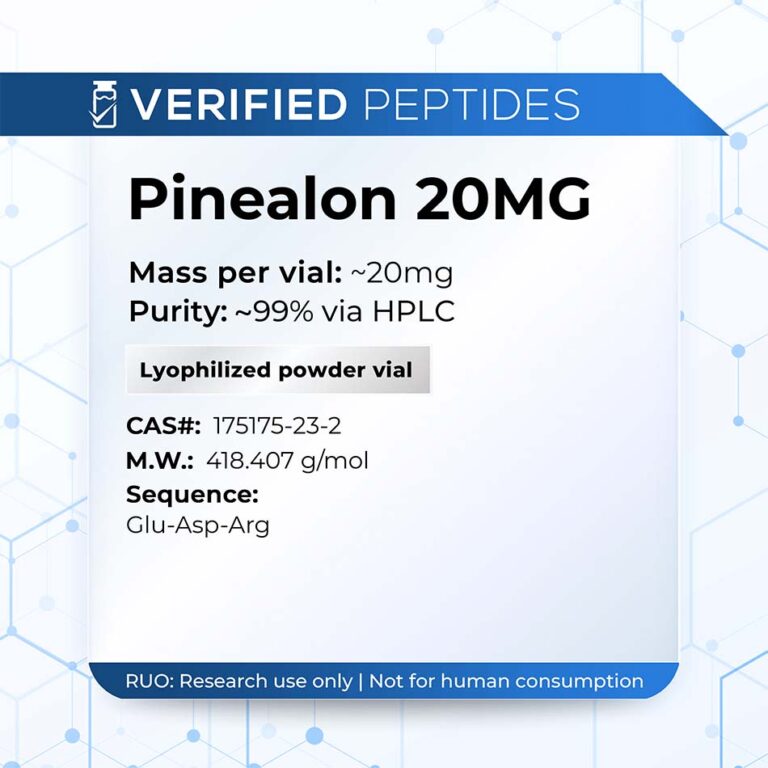
Pinealon (20MG)

Price range: £41.00 through £55.00
Pinealon 20mg is a peptide research product intended for controlled laboratory research and analytical investigation. Global Peptides Lab highlights three important testing parameters: purity, product weight, and endotoxins (LPS). Researchers should consult the available batch-specific documentation for actual results, analytical methods, and product specifications before use in a laboratory study.
Testing parameters: Purity | Weight | Endotoxins (LPS)
Research use only. Not intended for human or veterinary use, consumption, diagnosis, or treatment of any disease.
Pinealon 20mg – Research Peptide
Pinealon 20mg is a peptide research product offered by Global Peptides Lab for laboratory investigation and analytical research. When evaluating a research peptide, it is important to consider product identification, stated quantity, purity testing, and relevant quality-control documentation before making a purchasing decision.
This product page provides an overview of the available product information and highlights three important testing parameters: purity, weight, and endotoxins (LPS). These parameters help researchers understand what documentation to look for when assessing the suitability of a material for a particular laboratory research protocol.
Global Peptides Lab aims to present product information in clear, accessible English so that customers can review the available specifications and make informed decisions about research materials. Actual product characteristics and analytical results should always be confirmed using the documentation supplied for the relevant batch.
What Is Pinealon?
Pinealon is the name used for a synthetic peptide studied in scientific literature relating to peptide biology and experimental research. It is commonly discussed in connection with research into short peptides and their potential biological interactions. However, the existence of scientific interest does not establish that a substance is a proven treatment or that it is safe and effective for use in humans.
Researchers investigating Pinealon should distinguish between preliminary laboratory findings, animal research, proposed biological mechanisms, and evidence from well-designed human clinical trials. These categories of evidence are not interchangeable, and results from one research setting cannot automatically be applied to another.
For this reason, Global Peptides Lab focuses on product identification, research context, and quality-related information rather than making unsupported claims about health benefits or clinical outcomes.
Key Product Information
Product name: Pinealon
Listed quantity: 20mg
Product category: Research peptide
Supplier: Global Peptides Lab
Testing parameters listed:
- Purity
- Product weight
- Endotoxins (LPS)
The listed quantity identifies the product’s stated amount. Customers should consult the product label and applicable batch documentation to confirm the actual contents, measurement basis, and any additional specifications.
Specific analytical results, acceptance limits, and testing methods should be stated only when supported by current documentation. A testing category alone does not establish that a particular batch has passed a test.
Purity Testing
Purity is an important consideration when evaluating research peptides. Analytical purity results can help researchers assess the proportion of the detected material attributed to the target compound under a specified analytical method.
Depending on the laboratory and method used, peptide analysis may involve techniques such as high-performance liquid chromatography (HPLC). Other analytical methods may be needed to establish molecular identity or investigate additional characteristics.
It is important to understand that a reported purity percentage is not necessarily equivalent to the total amount of target peptide in a vial. Purity, identity, quantity, moisture content, and other product characteristics are distinct measurements.
When reviewing Pinealon research material, customers should look for a batch-specific certificate of analysis (COA), where available. The document should identify the material, describe the analytical method, provide the reported result, and include sufficient information to establish which batch was tested.
Global Peptides Lab lists purity as one of the product’s testing parameters. The numerical result and test method should be confirmed through the relevant laboratory documentation rather than assumed from the product listing.
Product Weight Verification
Product weight is another important quality-control parameter. The stated quantity of a research material should be supported by appropriate weighing, filling, or analytical procedures, depending on the manufacturer’s process and the claim being made.
For a product labelled 20mg, researchers should distinguish the nominal quantity from any independently verified measurement. The net amount of peptide, total material in a container, and the amount of other substances present are not necessarily identical.
Reliable documentation helps clarify what was measured, which method was used, and whether the reported quantity refers to the peptide itself or the total contents.
Customers evaluating Pinealon 20mg should review the available product specifications and batch records for information about the declared quantity. Where a weight test is listed, the corresponding report should identify the measurement and its result.
Endotoxins (LPS) Testing
Endotoxins are components of the outer membrane of certain Gram-negative bacteria. Lipopolysaccharides, commonly abbreviated as LPS, can be relevant to the assessment of materials intended for particular types of laboratory research.
Endotoxin testing is different from purity testing. A material may have a high reported chemical purity while still requiring separate assessment for endotoxin contamination. Likewise, an endotoxin result does not by itself establish the material’s identity, overall purity, or suitability for a specific research application.
The relevance of an endotoxin limit depends on the intended research setting, the applicable protocol, and the requirements of the relevant laboratory. Analytical methods and reported units should be considered when interpreting a result.
Global Peptides Lab identifies endotoxins (LPS) as a testing parameter for this product. Customers should request or consult the applicable test report to verify the reported value, analytical method, and any relevant acceptance criteria. No specific endotoxin level or pass result should be assumed without supporting documentation.
Storage and Handling Considerations
Research materials should be stored and handled according to the manufacturer’s current product documentation and the requirements of the laboratory in which they are maintained.
Storage conditions can vary according to formulation, packaging, moisture sensitivity, temperature stability, and other material characteristics. For that reason, a single storage temperature or shelf life should not be assumed without product-specific supporting information.
Keep the material appropriately labelled and secured, follow relevant laboratory procedures, and consult the supplier’s documentation for any specified environmental conditions or handling precautions. Researchers should also follow applicable institutional requirements for receiving, recording, and storing laboratory materials.
If the packaging, label, or supplied documentation is damaged, incomplete, or inconsistent with the order, contact the supplier for clarification before proceeding with research activities.
Why Review Product Documentation Before Ordering?
Selecting a research peptide involves more than looking at the product name and stated quantity. Documentation can help researchers determine whether a material’s identity, analytical results, and declared specifications are appropriate for their intended laboratory work.
Before ordering, consider checking the following:
- Product identification: Confirm the product name and any available identity information.
- Declared quantity: Review the labelled amount and applicable weight documentation.
- Purity results: Look for a reported result and the analytical method used.
- Endotoxin information: Check whether a batch-specific result and relevant testing details are available.
- Batch traceability: Confirm that the supplied documentation corresponds to the batch being purchased.
- Handling information: Review any available storage and laboratory-handling requirements.
These checks help establish a clearer understanding of the material being considered. They also help distinguish documented specifications from general product descriptions.
About Global Peptides Lab
Global Peptides Lab provides product information for customers researching laboratory materials. Our product pages are intended to make key details easier to review, including product identification, listed quantity, and relevant quality-control information.
For Pinealon 20mg, the listed testing categories are purity, weight, and endotoxins (LPS). Customers should consult the available supporting documentation for actual analytical results and batch-specific details.
If you require clarification about the product label, listed specifications, or available testing documents, contact Global Peptides Lab before placing your order.
Frequently Asked Questions
What is Pinealon 20mg?
Pinealon 20mg is a research peptide product identified by its product name and stated quantity. Researchers should consult the product label and available batch documentation for further specifications.
What testing parameters are listed for this product?
The listed parameters are purity, product weight, and endotoxins (LPS). Actual results, test methods, and acceptance criteria should be verified using the applicable laboratory reports.
Does a purity result confirm the identity of a peptide?
Not by itself. Purity and molecular identity are different analytical characteristics. Appropriate supporting methods and documentation may be needed to assess each one.
What does LPS mean in endotoxin testing?
LPS stands for lipopolysaccharide, a component of the outer membrane of certain Gram-negative bacteria. Endotoxin testing assesses a different quality attribute from chemical purity testing.
Is Pinealon approved as a treatment for a medical condition?
This product listing does not establish approval or clinical effectiveness for any medical condition. Research interest should not be interpreted as proof of safety or therapeutic benefit.
How should the product be stored?
Follow the supplier’s current, product-specific documentation and applicable laboratory procedures. Do not assume a storage temperature or shelf life that has not been verified for the supplied material.
Is this product intended for human consumption?
No. This product is presented for research purposes only and is not intended for human or veterinary use, consumption, diagnosis, or treatment.
Important Research Disclaimer
Pinealon is offered here as a research material. This listing is not medical advice and does not establish clinical safety, efficacy, or approval for human use. Customers are responsible for ensuring that their research activities comply with applicable laws, institutional requirements, and relevant laboratory safety procedures.
Product specifications and testing claims should be confirmed through the current label and supporting documentation. Testing parameters listed on this page do not constitute a guarantee of a particular analytical result unless that result is documented for the applicable batch.
| Quantity | 1-4, 10-24, 20+, 5-9 |
|---|
Be the first to review “Pinealon (20MG)”
Related products

Peptides

Peptides

Peptides

Peptides


Peptides

Peptides
Reviews
There are no reviews yet.