
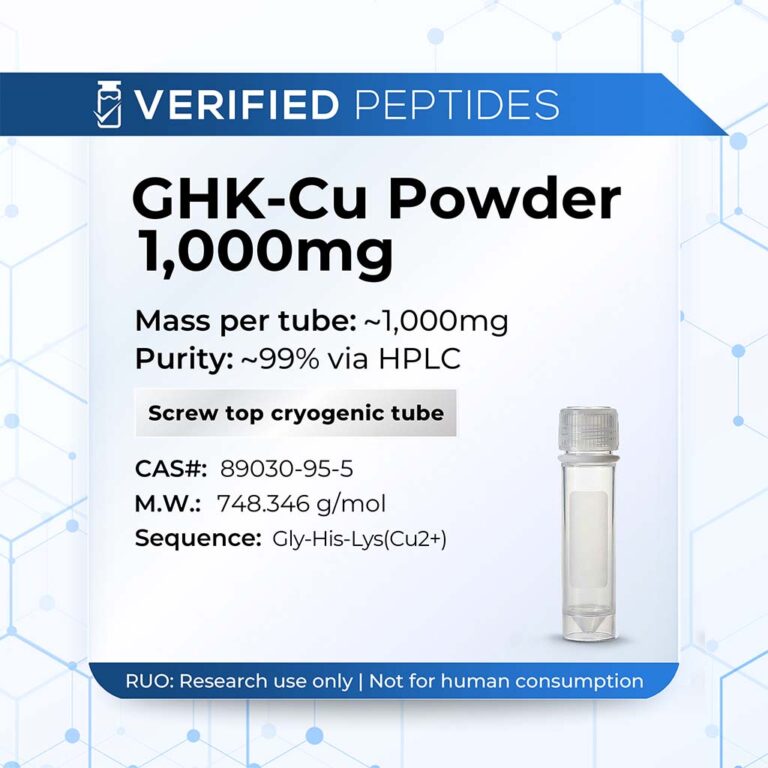
Powder: GHK-Cu 1000MG

Price range: £41.00 through £55.00
GHK-Cu 1000MG is a copper-binding peptide intended for laboratory research and scientific investigation. Known in scientific literature as a complex involving glycyl-L-histidyl-L-lysine and copper, GHK-Cu is studied for its biochemical properties and interactions with biological systems.
At Global Peptides Lab, product quality information focuses on two key testing parameters: purity and identity. Review the available analytical documentation and product specifications before use in a research setting.
Testing information:
- ✓ Purity
- ✓ Identity
GHK-Cu 1000MG – Copper Peptide for Laboratory Research
GHK-Cu 1000MG is a copper-binding peptide product offered by Global Peptides Lab for laboratory research and scientific investigation. GHK-Cu is the commonly used name for a copper-associated form of the tripeptide glycyl-L-histidyl-L-lysine (GHK). This peptide has attracted scientific interest because of its copper-binding properties and its role in several areas of biochemical research.
Researchers studying copper peptides may investigate their molecular structure, chemical characteristics, and interactions under controlled laboratory conditions. This product page provides an overview of the compound, its research context, and the quality information that should be considered when evaluating a peptide for laboratory work.
At Global Peptides Lab, we aim to present product information in clear, straightforward English so researchers can review the essential details before making a purchasing decision.
What Is GHK-Cu?
GHK-Cu is associated with a naturally occurring tripeptide known as GHK, which consists of three amino acids: glycine, histidine, and lysine. The peptide can bind copper ions, forming a complex commonly referred to as copper peptide GHK-Cu.
Copper is an essential trace element involved in various biological processes. Its interactions with proteins and other molecules make copper-containing compounds an area of interest in biochemistry and related scientific disciplines.
GHK-Cu has been investigated in scientific literature concerning cellular processes, extracellular matrix biology, and skin-related research. However, findings from laboratory experiments do not automatically establish clinical benefits, product effectiveness, or safety in humans.
For this reason, GHK-Cu should be evaluated according to the available scientific evidence and the specific requirements of the intended research application.
GHK-Cu 1000MG Product Overview
The GHK-Cu 1000MG product is presented in a 1000 mg labelled quantity. Researchers should confirm the supplied form, composition, packaging, and analytical specifications on the product label and accompanying documentation.
The amount stated in a product name describes its labelled quantity. It does not independently confirm the compound’s purity, copper content, concentration, or suitability for a particular experiment.
When selecting a peptide for laboratory work, it is important to review the product specification sheet, batch information, storage recommendations, and any available analytical results.
These details help researchers assess whether a material meets the requirements of their intended experimental protocol.
Key Product Features
1. Copper Peptide Research
GHK-Cu is studied as a copper-binding peptide with distinctive biochemical properties. Researchers may examine its molecular characteristics, interactions with copper, and behaviour under defined experimental conditions.
The scientific relevance of a particular result depends on the experimental design, analytical methods, and conditions used during the investigation.
2. Purity Testing
Purity is an important quality parameter when evaluating laboratory peptides. It relates to the proportion of the intended substance in a sample relative to detectable impurities, as defined by the analytical method used.
The product is listed as being tested for purity. Researchers should consult the relevant batch-specific test report for the measured result, analytical method, and acceptance criteria.
A purity claim should not be interpreted as proof that a material is completely free from impurities.
3. Identity Testing
Identity testing helps determine whether a sample is consistent with the intended compound. Depending on the laboratory and the substance being tested, methods may include mass spectrometry, chromatography, or other suitable analytical techniques.
GHK-Cu is listed as being tested for identity. The accompanying documentation should be reviewed to establish which method was used and what the results demonstrate.
Identity testing and purity testing measure different characteristics, so one should not be treated as a replacement for the other.
4. Clear Product Information
Global Peptides Lab presents product details to help customers understand the material they are evaluating. Before purchasing, researchers should verify the labelled quantity, supplied form, available documentation, and any relevant handling requirements.
Product specifications should always take precedence over assumptions based on a product name or general descriptions of copper peptides.
Scientific Research on GHK-Cu
Scientific interest in GHK-Cu includes investigations into copper binding, cellular signalling, extracellular matrix processes, and biological pathways studied in skin and tissue research.
Some published studies have examined GHK-related compounds in laboratory models. Nevertheless, evidence varies according to the experimental setting, and results obtained in cell cultures or other preclinical models cannot automatically be applied to people.
Research findings also depend on the exact substance, its chemical form, the analytical quality of the sample, and the methods used to conduct the study.
Researchers should consult peer-reviewed publications and relevant safety documentation when planning experiments involving copper-binding peptides.
The presence of scientific publications about a compound does not establish that every commercially available preparation has the same characteristics or produces the same results.
Product Quality and Analytical Documentation
At Global Peptides Lab, two important quality parameters identified for this product are purity and identity.
These checks serve different purposes:
- Purity: Provides information about the sample’s composition according to the analytical method used.
- Identity: Provides evidence about whether the tested material is consistent with the intended compound.
When available, a certificate of analysis (COA) can provide additional information about a particular batch. Depending on the supplier and testing laboratory, it may identify the analytical methods, results, batch number, and test date.
Customers should review the actual documentation rather than relying solely on general product statements. Unless supported by documentation, no specific purity percentage, independent laboratory certification, sterility status, or endotoxin result should be assumed.
Storage and Handling
GHK-Cu should be stored and handled according to the manufacturer’s product label and the applicable laboratory safety documentation.
Storage requirements can vary depending on the material’s supplied form, packaging, formulation, and stability data. Keep the product in its original labelled packaging when appropriate, protect it from unsuitable environmental conditions, and follow any specified temperature and light-protection requirements.
Laboratory personnel should use appropriate protective equipment and follow their institution’s chemical and biological handling procedures. Avoid handling the material outside the conditions specified by its supplier and the applicable safety documentation.
Do not assume that a particular storage temperature or shelf life applies unless it is confirmed by the product’s specifications.
Frequently Asked Questions
What is GHK-Cu 1000MG?
GHK-Cu 1000MG is a labelled quantity of a copper-binding peptide product intended for laboratory research. The supplied composition and specifications should be confirmed using the product label and available analytical documentation.
What is GHK-Cu used for in scientific research?
GHK-Cu has been investigated in areas of biochemistry, copper binding, cellular processes, and skin-related research. The relevance of any findings depends on the study design and the evidence available.
Is this product tested for purity and identity?
The product is listed as tested for purity and identity. Review the available batch-specific analytical documentation to confirm the methods and results.
Does purity testing guarantee that a peptide is safe?
No. Purity testing alone does not establish overall safety, sterility, absence of endotoxins, suitability for human use, or effectiveness. Those are separate considerations requiring appropriate evidence and testing.
What should I check before purchasing?
Review the labelled quantity, product specifications, supplied form, batch information, available certificate of analysis, and applicable handling requirements. Confirm that the material meets your laboratory’s requirements before purchasing.
How should GHK-Cu be stored?
Follow the storage instructions supplied with the specific product. Requirements depend on its form, packaging, and documented stability characteristics.
Order GHK-Cu from Global Peptides Lab
Global Peptides Lab provides product information to support informed evaluation of laboratory research materials. When considering this copper peptide, review the product specifications and available analytical documentation before placing an order.
For research use, quality assessment should involve more than the product name or labelled quantity. Purity results, identity confirmation, batch traceability, and suitable handling information all contribute to a more complete evaluation of laboratory materials.
Important notice: This product is offered for laboratory research purposes only. It is not intended for human or veterinary use, self-administration, diagnosis, treatment, or prevention of any disease.
| Quantity | 1-4, 10-24, 20+, 5-9 |
|---|
Be the first to review “Powder: GHK-Cu 1000MG”
Related products

Peptides

Peptides

Peptides

Peptides

Peptides

Peptides

Peptides

Peptides
Reviews
There are no reviews yet.